
The UN Secretary-General’s Special Advocate for Financial Health met women entrepreneurs using Affinity’s banking services, highlighting the role of accessible financial solutions in supporting small businesses and building financial resilience.
Accra, Ghana – 9 November 2026. Affinity Africa, Ghana’s leading digital banking platform, was part of Her Majesty Queen Máxima of the Netherlands’ official programme in Ghana, which included a visit to Affinity customers at Makola Market in Accra on Tuesday, 3 November. Queen Máxima, who serves as the United Nations Secretary-General’s Special Advocate for Financial Health (UNSGSA), met women traders using Affinity’s financial services and heard firsthand how access to payments, savings and loans is helping entrepreneurs manage their finances, run their businesses and plan for the future.
During her 2–5 November visit, focused on advancing financial health in Ghana, Queen Máxima spoke with Joyce Ketu, an Affinity customer rebuilding her business following a fire. Her experience highlighted how access to savings, loans and personal support can help small business owners navigate financial challenges, while underscoring the importance of insurance, which Affinity is introducing, and longer-term financing in protecting livelihoods and supporting future growth.
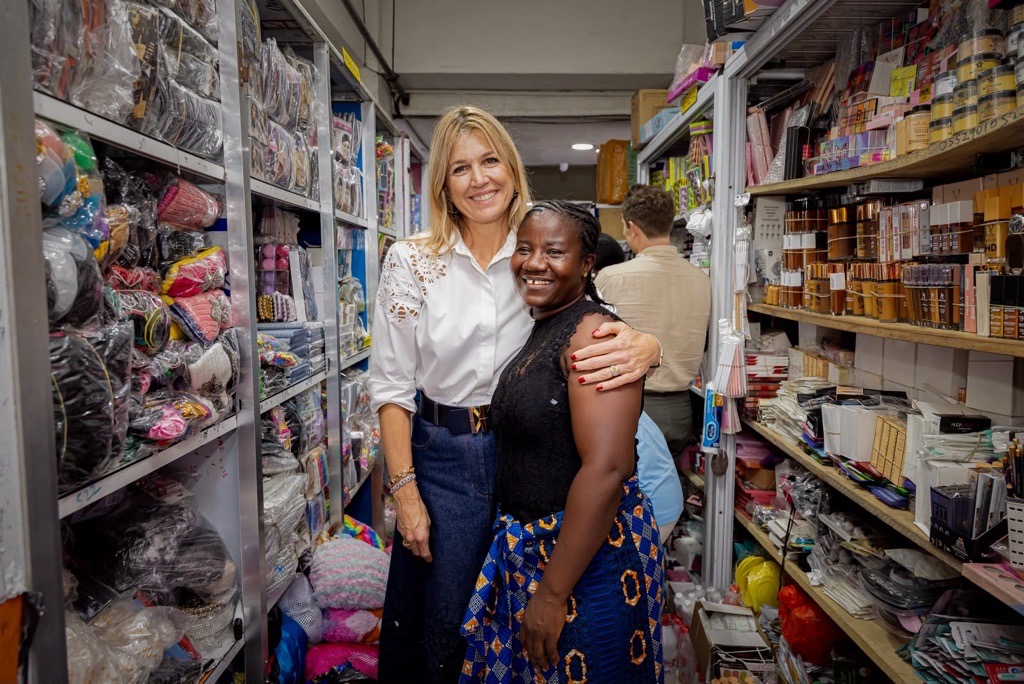
For many small business owners, financial health means balancing the needs of their businesses with those of their households. Having money available to restock, cover everyday expenses and cope with unexpected setbacks can make a significant difference to their financial stability.
“Financial inclusion is not simply about giving people access. It’s about providing the tools they need to manage their finances, grow their businesses and build resilience for when unexpected challenges arise,” said Dr Tarek Mouganie, Founder of Affinity Africa. “The experiences shared by entrepreneurs at Makola Market reflect the realities of millions of people across Ghana. At Affinity, we’re building banking services that are accessible, affordable and genuinely relevant to our customers’ everyday lives. That is financial health.”
Since launching publicly in October 2024, Affinity Africa has reimagined banking through a fully digital platform offering free personal and business accounts, savings, investment products, seamless payments, transfers, and one of Ghana’s most affordable lending portfolios. The company has grown to over 150,000 customers.
HM Queen Máxima’s visit comes at an important moment for Ghana’s financial sector. According to the World Bank’s Global Findex 2025, 81% of adults held a financial account in 2024, up from 29% in 2011. Yet ensuring that greater financial access translates into lasting financial health remains a critical priority.
Accra and London, 17 June — Affinity Africa, Ghana’s leading digital banking platform, has released a new report in collaboration with the Mo Ibrahim Foundation and Yale’s International Leadership Centre examining the drivers and impacts of cash dependency in Africa and the steps required to address it.
The full report is available for download here.
The research makes clear that Africa’s cash dependency is not a technology problem. The continent already processes 74% of global mobile money volume — representing $1.1 trillion in value across 1.1 billion accounts in 2024. The problem is that digital payments do not yet outperform cash for merchants, households, and small businesses, resulting in more than 90% of mobile money value being withdrawn immediately upon receipt.
“The gap between the financial infrastructure Africa has built and the economic behaviour it was supposed to change is vast, and the cost of that gap compounds every year,” said Tarek Mouganie, Founder and Group CEO of Affinity Africa. “The problem is incentives. Digital payments do not yet outperform cash where it actually matters. Until digital is cheaper, more reliable, more accessible and more useful than cash at that level, the reality will not change”
The dependency on cash has significant economic consequences. Small and Medium Enterprises (SMEs), which account for roughly 80% of jobs and are often entirely cash-based, receive less than 5% of bank credit — contributing to a $330bn financing gap. Disproportionately high remittance fees, averaging 8.7% against the 3% SDG target, drain a further $8 billion annually from African households. Meanwhile, 85% of African workers remain in the informal sector, outside the tax base, limiting governments’ capacity to fund essential services.
“The SME financing gap, the annual remittance tax, the number of workers outside the formal economy — these are not inevitable features of the continent,” said Emma Sky OBE, Founding Director of Yale’s International Leadership Center. “They are the cost of an unfinished transition. Closing that gap is among the highest leverage moves available to anyone serious about Africa’s flourishing.”
The report makes clear that the issue can be addressed if the development of digital infrastructure is aligned with incentives, setting out three core actions that must happen together and in sequence — each creating the conditions for the next — to break cash dependency:
1. Make digital cheaper than cash for merchants: Regulators to cap merchant discount rates and provide fee subsidies for small merchants, while governments accelerate the shift by requiring digital payment acceptance for all government services, licences, and transfers.
2. Mandate interoperability: Regulators to mandate real-time settlement across platforms, enforce cross-border connectivity within regional economic blocs, and apply financial penalties for non-compliance.
3. Create reasons to stay digital: Regulators to give new digital innovators the headroom to offer credit, savings, and insurance products at scale; operators to provide transaction data as the basis for credit underwriting; and innovators to be given open APIs to build fintech products on existing payment rails.
Alongside the three core actions, the research also includes a detailed overview of the responsibilities of the other relevant stakeholders across Africa’s digital financial infrastructure – including governments, banks, Development Finance Institutions and investors – and the lessons that can be learnt from other markets in Africa and around the world.
“Incremental reform will not be enough. The public sector must move faster in building the regulatory clarity, institutional coordination, and governance frameworks capable of supporting Africa’s next phase of economic transformation,” said Mo Ibrahim, Founder and Chair of the Mo Ibrahim Foundation. “Because ultimately, ownership cannot exist without accountability, and economic autonomy cannot exist without strong institutions.”
The report calls actors to come together and address the issue as a matter of urgency. By 2050, one in four people in the world will be African — the window to get this right is narrowing, and the cost of incrementalism rises every year.
The full report is available for download here.
Media contacts: press@affinityafrica.com and will.king@thorndonpartners.com
About Affinity Africa
Affinity Africa is a digital banking platform founded by Tarek Mouganie and headquartered in Ghana, dedicated to providing affordable and accessible financial services to underserved and unbanked individuals, and micro, small, and medium enterprises (MSMEs). Powered by a proprietary technology platform, a branchless business model, and robust credit underwriting capabilities, Affinity offers 24/7 banking services tailored to both digital natives and users with limited digital literacy, driving financial inclusion at a low cost. Affinity is among the most affordable and cost-effective players in the region.
The company was founded in 2022, when it received a Savings and Loans license from the Bank of Ghana, the first of its kind granted in over 10 years, and officially launched operations in October 2024, following the regulatory approval of its mobile app. Today, it offers a comprehensive suite of products, including personal and SME accounts, savings, payments, transfers to banks and mobile money wallets, investments, and loans.
Affinity has made a profound impact in the region. It has empowered a large underserved population with easy-to-use affordable banking services, and it has financially included thousands of Africans into the system, who had been previously neglected by traditional banks: 65% of Affinity’s customers never had access to formal banking products and 60% are women operating in the informal sector.
To date, Affinity has raised US$13 million in total funding, including an US$8 million Seed Round, to support its mission to bridge the financial services gap across Sub Saharan Africa.
About the Mo Ibrahim Foundation
Founded in 2006, the Mo Ibrahim Foundation aims to amplify Africa’s voice on global issues, with a focus on the importance of governance and leadership. The Foundation provides data and analysis on the continent’s challenges, brings together key actors for discussion, and supports initiatives to improve leadership and governance.
In this regard, the Foundation concentrates on defining, assessing, and improving governance and leadership in Africa as key drivers of the continent’s progress. The Foundation places particular importance on African youth, recognising them as key actors in building their own continent. This goal is achieved through five key initiatives:
– Ibrahim Index of African Governance
– Ibrahim Prize for Achievement in African Leadership
– Ibrahim Governance Weekend
– Ibrahim Fellowships and Scholarships
– Now Generation Network.
About Yale’s International Leadership Centre
Yale’s International Leadership Center is an incubator and platform that develops and supports innovative, effective, and adaptive leaders to address the most acute and complex challenges facing the world. Located in Yale’s Jackson School of Global Affairs, the ILC facilitates the growth of leaders dedicated to preventing conflict and building better societies.
Through international competitions, the ILC identifies exceptional rising leaders from government, the private sector, and civil society, and provides them with opportunities to deepen and broaden their knowledge, skills, and networks and to access world-leading research, scholars, and practitioners.
A customer-inspired product that lets users set savings goals, choose flexible tenors, and top up funds to grow their money faster. Designed to make every Cedi count.
Accra, August 2025 – Affinity Africa, Ghana’s leading digital banking platform, announces the launch of Affinity Boost, a new goal-based savings account designed to help individuals and small business owners accelerate their financial goals by earning competitive returns. With this new product, Affinity continues to reimagine digital banking in Africa by offering inclusive, flexible, and high-yield financial products that put customers in control of their money.
Affinity Boost enables customers to set specific savings goals—such as buying a motorcycle, starting a business, or booking a trip—and choose a fixed period of time (tenor) to grow their money, earning a competitive annual interest. What sets the product apart is that it also introduces a top-up functionality, allowing users to add extra funds at any time or set up automated daily/weekly/monthly scheduled transfers into the account to increase their returns and reach their goals faster.
“This product was built in response to real feedback from our customers, many of whom wanted the option to add more money into their yield-generating accounts when they had extra cash,” said Abdul-Jaleel Hussein, CEO of Affinity Ghana. “Affinity Boost is a direct result of listening to the voice of our customers and building for what matters most: helping them achieve their goals”.
The launch of Affinity Boost expands the company’s suite of transactional and high-yield savings accounts—Affinity Daily, Affinity Growth and Affinity Future— which offer a range of tenor and return combinations tailored to meet different financial needs and customer profiles. Whether customers prefer daily liquidity, shorter terms for quick wins or longer durations for higher returns, they will find the perfect option for them within Affinity’s flexible deposit products. Beyond savings, Affinity also provides a robust lending portfolio with some of the best rates in the market—including Instant Loans, short-term Working Capital, and long-term Growth Capital—empowering individuals and MSMEs to access affordable credit on their own terms.
Along with Affinity Boost, the company is introducing a newly redesigned app and website. In the app, customers can have full visibility on their savings progress via an intuitive and transparent dashboard, as well as easy-to-use, simple interface to do daily tasks like payments and deposits. In the website experience, users can access web-banking tools and even apply for an instant loan with a few clicks.
Affinity has seen rapid adoption of its digital banking services: with over 80,000 customers onboarded, roughly 80% are actively using mobile app. Notably, 55% of customers who started with Affinity’s agent network later transitioned to using the mobile app, underscoring the platform’s role in driving financial and digital literacy.
“As more Africans demand smarter tools to manage their finances, we remain committed to designing banking products that serve their needs,” added Tarek Mouganie, Founder and Group CEO of Affinity Africa.
For more information, visit www.affinityafrica.com.
About Affinity Africa
Affinity Africa is a digital banking platform founded by Tarek Mouganie and headquartered in Ghana, dedicated to providing affordable and accessible financial services to underserved and unbanked individuals, and micro, small, and medium enterprises (MSMEs).
Powered by a proprietary technology platform, a branchless business model, and robust credit underwriting capabilities, Affinity offers 24/7 banking services tailored to both digital natives and users with limited digital literacy, driving financial inclusion at a low cost. With no monthly fees or transaction charges, Affinity is among the most affordable and cost-effective players in the region.
The company was founded in 2022, when it received a Savings and Loans license from the Bank of Ghana, the first of its kind granted in over 10 years, and officially launched operations in October 2024, following the regulatory approval of its mobile app. Today, it offers a comprehensive suite of products, including personal and SME accounts, savings, payments, transfers to banks and mobile money wallets, investments, and loans.
Affinity has made a profound impact in the region. It has empowered a large underserved population with easy-to-use affordable banking services, and it has financially included thousands of Africans into the system, who had been previously neglected by traditional banks: 65% of Affinity’s customers never had access to formal banking products and 60% are women operating in the informal sector.
To date, Affinity has raised US$13 million in total funding, including an US$8 million Seed Round, to support its mission to bridge the financial services gap across Sub-Saharan Africa.
More information at: https://www.affinityafrica.com